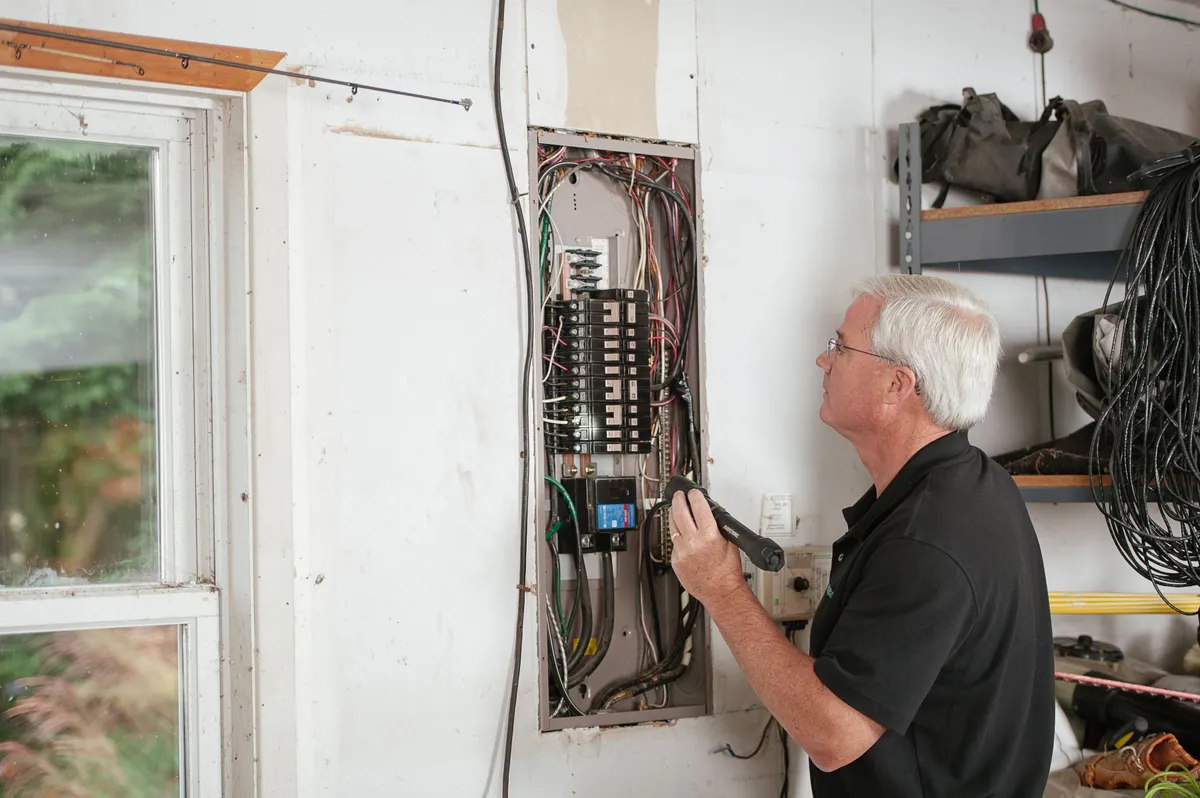
If your Pahrump home still runs on an original builder-grade panel — and a lot of the valley’s 1990s-to-2005 housing stock does — the panel upgrade is the big-ticket electrical job you’re most likely to face. Here’s the short answer for 2026: most 200-amp panel upgrades cost $1,300–$2,500. A straight breaker-panel swap where the existing service equipment stays runs $1,300–$1,600; a job that requires a new service panel runs $1,800–$2,500. The rest of this guide unpacks where inside (or outside) that range your quote is likely to land, and why.
Our methodology, up front: the ranges below are 2026 national figures from published cost datasets (primarily HomeGuide’s 2026 cost research), reviewed in July 2026. They’re the ranges real quotes usually land inside — not promises. Pahrump quotes vary with travel distance, the condition of your service entrance, and job access, so get two or three written local quotes before committing. For rates and service-call fees, see the full Pahrump electrician cost guide.
Panel upgrade costs: the 2026 table
| Job | 2026 typical range |
|---|---|
| 200A upgrade (breaker swap, existing service OK) | $1,300–$1,600 |
| 200A upgrade (new service panel required) | $1,800–$2,500 |
| New 100A service | $1,200–$1,600 |
| Upgrade to 400A | $2,000–$4,000 |
| Fuse box → breaker panel | $1,100–$4,000 |
| Subpanel (garage, shop, addition) | $500–$1,000 |
| Move a panel to a new location | $1,000–$4,000 |
| Main breaker replacement only | $40–$100 part + $50–$100/hr labor |
One note on what the table can’t show: the ranges assume reasonable access and a service entrance in workable condition. Pahrump’s housing boom ran roughly 1990s through 2005, which means a large wave of original panels and exterior service gear is now twenty to thirty-five years old — old enough that “while we’re in there” repairs are common, and worth budgeting headroom for on any quote at the bottom of a range.
Two quick clarifications on that table. First, “200A swap versus new service panel” is the fork that decides most Pahrump quotes — a swap reuses your existing meter base and service entrance; a new service panel means new equipment at the point where VEA’s wires meet your house. Second, a subpanel is not an upgrade: it redistributes capacity you already have, which is why it’s the cheap line on the table. If your main panel is already full and undersized, a subpanel alone won’t fix it.
What actually drives the price
The condition of your service entrance. This is the biggest wildcard in the valley. The mast, weatherhead, meter base, and service conductors live outside, and twenty-plus years of desert sun and 110-degree summers are brutal on them — UV-chalked mast heads, heat-cycled lugs, corroded meter bases. An electrician who opens up a sun-baked west-facing service entrance and finds damage isn’t upselling you; they’re finding what the desert did. This is the main reason a $1,300–$1,600 swap becomes a $1,800–$2,500 new-service job.
Code-triggered extras. A panel replacement has to meet current code even if the house was fine under the old code. That commonly means AFCI and GFCI breakers on circuits that never had them, grounding-electrode and bonding updates, and properly labeled circuits. AFCI/GFCI breakers cost more per position than plain breakers, so a panel with many protected circuits quotes higher than the same amperage with few. Ask the estimator to list which breakers are AFCI, GFCI, or dual-function and why.
Where the panel lives. An accessible garage panel is the easy case. Panels buried behind drywall, in closets (a code problem in itself), or in awkward exterior locations add labor. If the panel has to move entirely — common when a remodel or an addition swallowed the old location — budget $1,000–$4,000 for the relocation.
Manufactured homes. A large share of Pahrump’s housing is manufactured, and the service equipment is often a pedestal or exterior panel with feeder arrangements that differ from site-built homes, governed partly by HUD code. Not every electrician quotes them accurately. Make sure the quote says “manufactured home” on it, and see our mobile home electrical page for what’s different.
100A vs. 200A vs. 400A: how to decide
100 amps was standard for decades and still serves a small, all-gas home adequately. A new 100A service runs $1,200–$1,600 — but notice how close that is to the 200A swap range. When the price gap is that narrow, paying for capacity you’ll grow into usually wins.
200 amps is the modern default and the right answer for most Pahrump homes. The case gets stronger every year: central air conditioning working overtime all summer, an EV charger, a spa, a shop subpanel, or future solar all draw on panel capacity. If an EV charger is anywhere in your plans, read the EV charger installation cost guide before you size the panel — doing the panel and the charger circuit in one permitted job is cheaper than doing them eighteen months apart.
400 amps ($2,000–$4,000) is for genuinely large loads: big homes with multiple AC systems, a large shop, extensive vehicle charging. Most homeowners don’t need it, and the honest test is arithmetic, not ambition — ask any electrician recommending 400A to show you the load calculation that requires it.
The load calculation is the theme here. A competent electrician sizes a service from a documented calculation of your actual and planned loads. If the recommendation arrives without one, ask for it in writing.
Fuse boxes, Federal Pacific, and Zinsco: the insurance angle
Three types of legacy equipment get quoted for replacement on condition and insurability rather than capacity:
- Fuse boxes. Functional ones still exist, but insurers increasingly surcharge or decline them, and they predate every modern protection requirement. Conversion to a breaker panel runs $1,100–$4,000 depending on whether the service entrance comes along for the ride.
- Federal Pacific (FPE) Stab-Lok and Zinsco panels. Both brands have well-documented histories of breakers failing to trip. Replacement prices like a standard 200A upgrade — $1,300–$2,500 depending on service condition — and many home inspectors flag them automatically at sale.
If you’re buying or selling a Pahrump home with any of the three, get the replacement quoted early. And if an insurer is requiring the work, make sure it’s permitted and inspected — an undocumented replacement may not satisfy the requirement that prompted it.
Permits, inspections, and the VEA disconnect
Panel work in Pahrump has a two-agency reality that out-of-area cost guides never mention:
- Nye County Building & Safety requires a permit for panel changes and service upgrades, filed through the county’s Citizen Services portal, with inspection before the work is finalized. Work can’t be covered up before it’s inspected.
- Valley Electric Association — the member co-op that serves Pahrump, not NV Energy — controls the meter. A service upgrade means VEA disconnects power for the work and reconnects after, which the contractor has to schedule. Electricians who work the valley regularly have this choreography down; a contractor who’s never coordinated with VEA can leave you powerless — literally — waiting on a reconnect.
Permits are non-negotiable for a reason that has nothing to do with bureaucracy: an unpermitted panel is a defect that surfaces at the worst times. Home inspectors look for the sticker. Insurance adjusters ask about it after a fire. Buyers’ agents use it to negotiate. The permit and inspection are a small fraction of the job cost, and a quote that “saves” that money is transferring risk to you, not creating value.
Is it worth it?
A panel upgrade is one of the least glamorous things you can spend four figures on — nothing looks different afterward. The value shows up three ways. Capability: it’s the prerequisite for the EV charger, the spa, the shop, the solar array. Insurability and resale: modern, permitted service equipment removes an inspection objection and an insurance surcharge risk, which matters in a valley where much of the housing stock is reaching the age where panels get flagged. Safety margin: modern breakers, AFCI/GFCI protection, and sound connections are what stand between a fault and a fire. We won’t invent a percentage return on that — no honest source can — but “the house couldn’t pass inspection without it” is a real number at closing time.
How to read competing quotes
Panel quotes are only comparable line by line. When your 2–3 written quotes arrive, check each for:
- Panel brand and model, in writing. Reputable manufacturers differ in price; “a 200-amp panel” with no brand named is not a spec.
- Breaker schedule. How many AFCI, GFCI, or dual-function breakers, and which circuits get them. This is where identical-sounding quotes hide real differences.
- Service-entrance scope. Does the price include the mast, weatherhead, meter base, and service conductors if they need replacement — or is that a change order waiting to happen? In Pahrump’s sun, assume they’ll at least be evaluated.
- Grounding and bonding. Current-code grounding should be itemized, not discovered.
- Permit and VEA coordination. The quote should say who pulls the Nye County permit and who schedules the VEA disconnect/reconnect. “Permit by owner” on a service upgrade is a red flag.
- License number. Nevada electrical contractors hold an NSCB C-2 classification, and their ads and paperwork must carry the license number. Verifying it at nvcontractorsboard.com is free and takes two minutes.
Ways to save without cutting corners
- Bundle planned work into one permit. Panel plus EV circuit, panel plus subpanel — one mobilization, one inspection trip.
- Fix the actual problem. If one breaker failed and the panel is sound, a $40–$100 part plus an hour or two of labor beats a new panel.
- Don’t buy amperage without a load calc. 200A covers most homes; 400A should be justified on paper.
- Schedule it as a project, not an emergency. A dead panel on a July afternoon prices like the emergency it is. A planned upgrade books at standard rates.
- Get quotes from both sides of the hump. Pahrump-based and Las Vegas-based contractors both serve the valley, with different travel overhead. Comparing one of each is a useful sanity check.
Get written local quotes
Pahrump Electrician is an independent referral service — we don’t perform electrical work, and nothing above is a quote from us. It’s research, maintained so you can judge the quotes you receive against real 2026 numbers. When you’re ready, we’ll connect you with an independent, licensed local contractor for a free written estimate on your panel upgrade — start with the form below or the contact page, compare at least two quotes line by line, and verify the C-2 license before you sign.
Last reviewed August 2026. Pahrump Electrician is a free, independent referral service — we connect Pahrump-area homeowners with a licensed local electrical contractor who calls you back and does the work. We're the connector, not the crew.