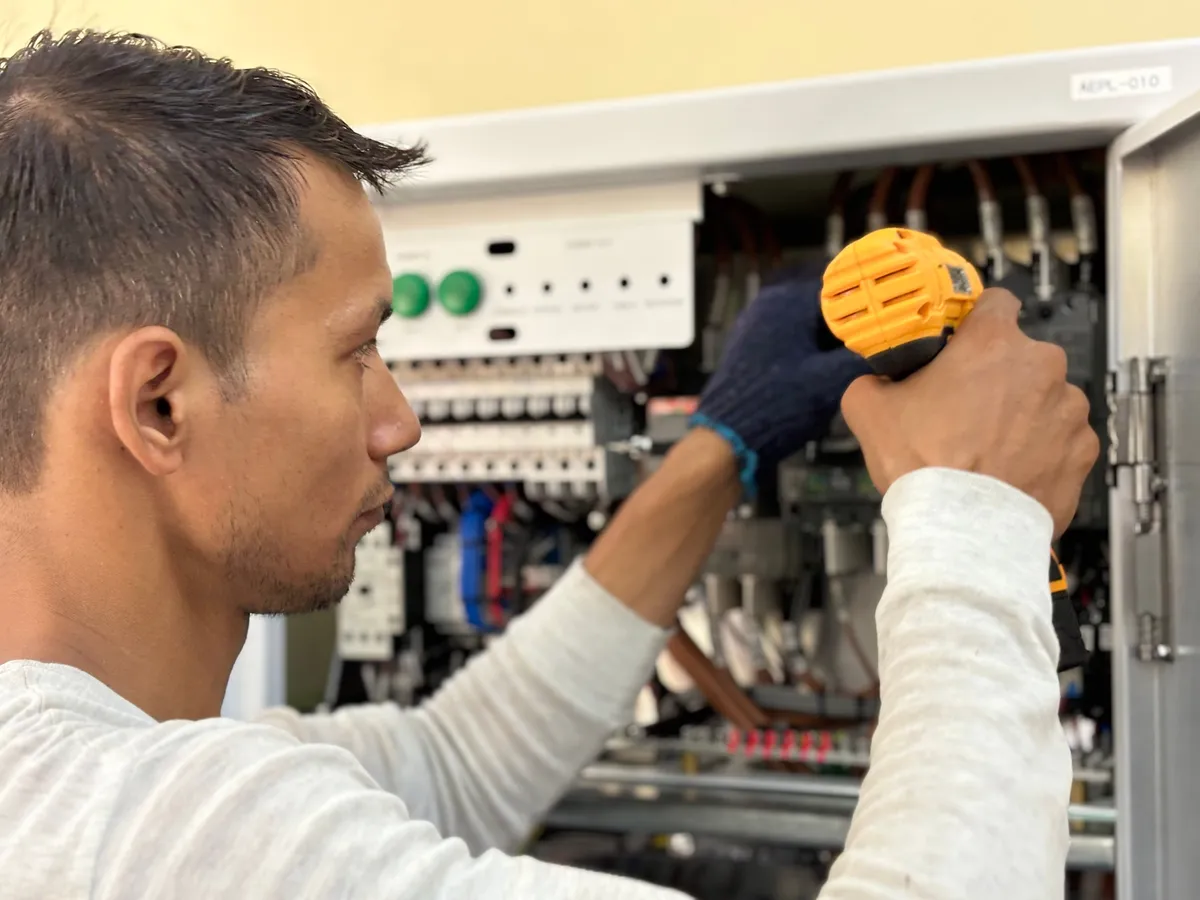
The electrical panel is the one component in your house that every light, outlet, and appliance depends on — and it’s also the component homeowners look at least. In Pahrump that neglect is riskier than in most places: a large share of the valley’s roughly 22,000 housing units went up during the 1990s–2005 building boom, which puts thousands of local panels at 20 to 35 years old, and desert conditions age service equipment faster than the same hardware would age in a mild climate.
This guide walks through the ten signs — some obvious, some subtle — that a panel is due for replacement, what’s genuinely urgent versus what can be scheduled, and what the work costs in 2026. We’re an independent referral service, not an electrician, so nothing here ends in “and that’s why you should hire us to rewire it.” It ends in you knowing whether to make a call.
The ten signs
1. Breakers trip when two big loads run together
The classic Pahrump version: the AC compressor kicks on while the dryer is running, and a bedroom circuit — or the main — lets go. An occasional trip is a breaker doing its job. A pattern of trips tied to load stacking is a capacity symptom: the panel doesn’t have the headroom your appliances need. If this is your main symptom, start with our breaker troubleshooting guide to rule out the simpler causes first — a single bad appliance or an overloaded circuit is a much cheaper fix than a panel.
2. Your panel is 100 amps or less — and you run central air
Check the number stamped on the main breaker (the big one, usually top center). Many older Pahrump homes were built with 100-amp service, which was reasonable for the loads of the era. Stack a modern 4–5 ton air conditioner, an electric range, a dryer, and — common in the valley — a private well pump on top, and 100 amps runs out of arithmetic. Modern practice for a home with central AC in this climate is 200-amp service.
3. You have a fuse box
Fuse boxes aren’t automatically dangerous, but they predate modern grounding and AFCI/GFCI protection, and they invite the classic dangerous improvisation: when a fuse keeps blowing, someone eventually installs a bigger fuse — or the infamous penny — and quietly removes the circuit’s protection. Insurers increasingly surcharge or decline fuse-equipped homes. Converting a fuse box to a breaker panel runs $1,100–$4,000 in 2026 depending on the condition of the service equipment behind it.
4. The label says Federal Pacific, FPE, Stab-Lok, or Zinsco
Open the panel door and read the label. Federal Pacific (FPE Stab-Lok) and Zinsco are the two well-documented problem brands of mid-century panels — FPE breakers in particular have a documented history of failing to trip under fault conditions, which is the single job a breaker has. Insurance underwriters know these names, which is why sign #10 below often arrives first. If your panel door carries one of them, replacement is the standard recommendation, priced like the 200-amp ranges below.
5. Warm breakers, buzzing, or a hot smell at the panel
A panel should be silent and roughly room temperature. Breakers that are warm to the touch, a buzz or crackle from inside, or any hot, acrid, or “fishy” electrical smell means a connection is loose, corroded, or arcing. This sign is different from the others on this list: it’s urgent. Arcing inside a panel is how electrical fires start. Don’t put this one on the someday list — if there’s an active burning smell, treat it as an emergency (our emergency electrician page covers how to triage it, day or night).
6. Lights flicker or dim when big appliances start
A brief dip when the AC compressor starts can be normal — motors draw a large inrush current. But flickering that’s new, worsening, or affects whole rooms points at loose connections or a service running out of capacity. There’s a full decision tree in our lights flickering guide, because flicker has several possible causes and only some of them are panel problems.
7. Scorch marks, rust, or corrosion at the panel
Browned or blackened marks around breakers mean something has already overheated. Rust or white oxide corrosion — common where a water heater, swamp cooler line, or roof leak has been near the panel, or where a sun-exposed exterior panel has weathered for decades — degrades the connections that carry your whole service. In Pahrump, panels mounted on west- or south-facing exterior walls take a genuine beating: UV-embrittled insulation and 120°F-plus surface temperatures are a local aging factor that inspectors here look for specifically. More on that in our desert heat guide.
8. There’s no room left for new circuits
Every slot full, or — worse — tandem (“cheater”) breakers doubled into slots that may not be rated for them. This shows up the moment you want to add anything: a spa, a shop subpanel, a freezer circuit in the garage. Sometimes a subpanel ($500–$1,000 installed) solves it without touching the main panel; a licensed electrician’s load calculation tells you which.
9. You’re adding an EV charger, solar, or a shop
A Level 2 EV charger wants a 40–60 amp dedicated circuit, which many older 100-amp panels simply can’t spare. This is why EV charger installs and panel upgrades are so often quoted together — see our EV charger installation page for the combined economics. Solar has its own interconnection requirements, and a detached shop typically wants a 60–100 amp feeder. All three trigger the same first step: a load calculation against your existing service.
10. Your insurer starts asking questions about the panel
An increasingly common way Pahrump homeowners discover a panel problem: the renewal paperwork asks for the panel brand, amperage, or a photo. Fuse boxes, FPE, and Zinsco are on underwriting checklists industry-wide, and “upgrade the panel or lose coverage” letters are no longer rare. If the insurer is asking, they already suspect the answer — check the label before you reply.
What’s urgent and what can be scheduled
Signs 5 and 7 — heat, buzzing, burning smells, scorch marks — are now problems: arcing and overheating are how panel fires start. Turn off what you safely can and get a licensed electrician out promptly; after hours, expect emergency rates of $150–$200/hr and read our emergency page first so you know what counts as a true electrical emergency.
Everything else on the list is a scheduled problem — real, but the kind you solve with quotes rather than a midnight phone call. That’s good news: scheduled panel work gets you competitive bids, permit timelines that suit you, and an install day you pick (aim for spring or fall — a panel swap means several hours without power, which in a Pahrump July matters).
What a panel upgrade costs in 2026
| Job | 2026 typical range |
|---|---|
| 200A upgrade — breaker panel swap, existing service OK | $1,300–$1,600 |
| 200A upgrade — new service panel required | $1,800–$2,500 |
| New 100A service (small homes, outbuildings) | $1,200–$1,600 |
| Upgrade to 400A (large homes, shops, heavy EV/solar) | $2,000–$4,000 |
| Fuse box → breaker panel conversion | $1,100–$4,000 |
| Subpanel installation (garage, shop, addition) | $500–$1,000 |
Most Pahrump homes doing the standard job land in the headline range: most 200A upgrades run $1,300–$2,500 installed. These are 2026 national ranges (HomeGuide cost datasets, reviewed July 2026) — Pahrump quotes vary with panel condition, service-entrance repairs, and travel; always get 2–3 written local quotes. The full line-item breakdown, including what moves a quote toward the top of each range, is in our panel upgrade cost guide.
What an upgrade actually buys you
It’s worth being clear that a panel upgrade isn’t just “the tripping stops.” A current-code panel replacement brings the modern protection layer your original panel predates, because replacing the panel triggers today’s code requirements even in an older home:
- AFCI breakers on most living-area circuits, which trip on the arcing signatures of damaged cords and loose connections — the failure mode behind a large share of house fires, and one an ordinary breaker can’t see.
- GFCI protection where required — kitchens, baths, garage, outdoors — guarding people rather than wire.
- Proper grounding and bonding brought to current standards, which is frequently where decades-old installs quietly fall short.
- Room to grow. Spare slots and service headroom for the additions Pahrump homes keep collecting: a spa, a shop, a freezer in the garage, and increasingly a Level 2 EV circuit.
- A whole-house surge protector, if you ask for it — panel-mounted SPDs are cheapest to add while the panel is already open, and monsoon season makes them an easy yes here.
- Insurance and resale standing. A modern panel with a closed county permit converts sign #10 from a threat into a checkbox — and it’s a question every future buyer’s inspector will have.
The upgrade conversation is also the natural moment to fix adjacent sun-damage: a weathered mast, a corroded meter base, brittle service- entrance insulation. Bundling that work while VEA has the meter pulled is meaningfully cheaper than mobilizing twice.
A note on manufactured homes
A large share of Pahrump’s housing stock is manufactured, and panels there earn their own paragraph: service equipment typically lives outdoors on a pedestal or pole taking full sun, feeder arrangements and HUD-code requirements differ from site-built homes, and some older mobile-home panels are on the same insurer watchlists as FPE and Zinsco. Every sign in this guide applies — the difference is that you want a contractor who quotes manufactured-home service equipment knowingly rather than discovering it on install day. Our mobile home electrical page covers what’s different and the questions to ask.
What happens after you decide
The job itself is more process than drama, and in Nye County it runs through a permit: your contractor files through the county’s Citizen Services portal, VEA (the valley’s member-owned utility co-op) schedules the disconnect and reconnect, and the county inspects before anything is closed up. The full sequence — including why a contractor who offers to “skip the permit” is handing you the liability — is covered in our Nye County electrical permits guide and on the panel upgrade service page.
One hiring note worth repeating from that page: electrical contracting in Nevada requires an active Nevada State Contractors Board license (the C-2 Electrical Contracting classification). Look the company up at nvcontractorsboard.com before you sign anything — it takes two minutes, it’s free, and Nevada law (NRS 624.720) even requires contractors to print the license number on their advertising, so a truck with no number on it is telling you something. If your home is manufactured — as a large share of the valley’s are — make sure the contractor quotes it as one; the service equipment differs, and our mobile home electrical page explains how.
The two-minute self-check
Before you call anyone, collect three facts: the brand on the panel label, the amperage on the main breaker, and a photo of the panel with the door open. That’s enough for any competent electrician to have a real conversation — and enough for you to spot the two instant-decision cases yourself (a fuse box, or an FPE/Zinsco label).
If you’d rather have a licensed local pro make the call, that’s what we’re here for: tell us what you found through our contact form and we’ll connect you with an independent Pahrump-area electrical contractor for a free quote. We don’t perform electrical work ourselves, and you deal with the contractor directly — license check and written quote firmly recommended, exactly as above.
Last reviewed August 2026. Pahrump Electrician is a free, independent referral service — we connect Pahrump-area homeowners with a licensed local electrical contractor who calls you back and does the work. We're the connector, not the crew.